
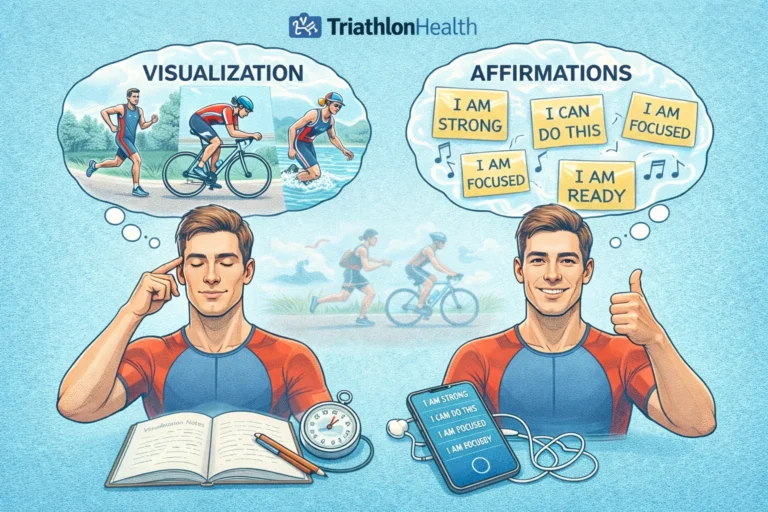
Mental strength can decide a triathlon outcome as much as swim splits, bike watts, or run pacing. This article compares visualization vs affirmations triathlonhealth style, so you can pick the best mental tools for training and race day. You will learn what each method does, how to practice them, what products help, and how to measure results.
visualization vs affirmations triathlonhealth: What each method is
Visualization uses mental imagery to rehearse performance. Athletes picture the swim, transitions, bike climbs, nutrition stops, and the finish. The images are vivid and sensory, including sight, sound, touch, and even smell. This trains the brain to run the exact scenes of a race, which can reduce surprises and stress.
Affirmations are short, positive statements repeated to shape beliefs and focus. They target inner talk, confidence, and calm. Examples include statements like, “I settle into my rhythm” or “I handle pain with control.” Repeating these phrases rewires responses to hard efforts and can stop negative loops during a race.
Both practices share the goal of improving mental readiness, but they use different routes. Visualization creates a rehearsal of actions and reactions. Affirmations guide internal language and mood. Choosing one or blending both depends on personal preference, experience, and the demands of a given race.
Trainers and sports psychologists often recommend combining methods. You might visualize the swim and then use affirmations to steady nerves before the start. The rest of this article compares benefits, gives exercises, and lists products to support either approach for triathletes focusing on triathlonhealth mental strategies and long-term gains.
How visualization boosts race performance
Visualization sets a detailed mental map of how a race will play out. When you picture exact motions and scenarios, your brain learns the pattern. That learning helps reduce hesitation and decision time during stressful points. It also helps keep effort consistent under fatigue.
Top pros use visualization to prepare for rare or chaotic events, like mass starts, bike crashes, or heavy winds. Practicing these scenarios mentally means they are not surprises on race day. When the unexpected happens, the athlete has a mental response already rehearsed, which keeps performance steady.
Visualization improves technical skills too. Rehearsing open-water sighting, getting into aero position on climbs, or quick T2 shoe changes can reduce wasted seconds. Imagining exact body movements tightens the neural pathways used for those actions, and that leads to cleaner execution under pressure.
Consistent visualization can also reduce pre-race anxiety. Repeating the mental scene until it feels normal makes the race feel familiar. Familiarity lowers stress, and lower stress keeps heart rate and breathing more stable before and during hard efforts.
What to visualize for triathlon
Focus your images on clear, repeatable moments. Picture the first 200 meters of the swim, your sighting every few strokes, and how you handle a drafting group. Visualize the first few minutes on the bike, how you shift gears and respond to a climb, and the exact point you take a bottle.
Include sensory details. Imagine water temperature, the feel of the wetsuit, the sound of waves, the pressure of the bike seat, the taste of your gel. Adding details makes the image stronger and more convincing to your brain. The stronger the image, the stronger the training effect.
Practice pacing images too. Visualize your power numbers, perceived effort, or target pace for each race segment. See yourself hitting those numbers and adjusting calmly if the plan changes. This keeps your internal pacing cues aligned with the objective numbers on race day.
How affirmations support focus and confidence
Affirmations work on the language loop inside your head. The words you repeat shape automatic beliefs and reactions. Short, specific phrases can replace negative self-talk that undermines effort. That is useful during long, painful hours on course.
Good affirmations are personal and credible. If a phrase feels false, it will not stick. Instead of saying, “I never get tired,” a believable affirmation could be, “I handle tough moments with steady breathing.” Believability helps the brain accept and act on the message.
Affirmations also help with heat, pain, and doubt. When a hard climb or a late-race fade comes, a practiced sentence can change attention from the pain to process. Athletes report that meaningful phrases shorten the perceived time spent in a painful phase and help them refocus on technique or nutrition.
Using affirmations before a race can anchor your mindset. Repeat your chosen lines during warm-up or in the transition area. Short phrases are easiest to recall under stress. That simplicity is one of the advantages of affirmations for race-day mental control.
Designing effective affirmations
Start with a small set, three to five lines that match your goals. Keep them short and present tense. For example, “I am calm at the start,” “I eat on time and stay fueled,” or “I run strong to the finish.” Present tense phrases reduce the gap between intent and action.
Make them specific to the situations that rattle you. If you get nervous before starts, use a phrase that addresses calm. If you lose focus on the bike, pick a line that rewires focus back to cadence and pacing. The closer the wording is to the problem, the more it helps.
Practice repetitions in multiple contexts: in warm-ups, during easy training sessions, and before sleep. The goal is to make the phrases automatic so that on race day they emerge without conscious effort. Repetition builds that automatic response faster than rare use.
Side by side: Which to choose on race day
Pick visualization when you need a mental rehearsal of skills, starts, or transitions. Visualization is excellent for technical preparation. It builds confidence in execution by rehearsing specific actions until they feel normal.
Choose affirmations when you need to manage inner talk and steady emotions. Affirmations are fast tools to change how you respond to pain, doubt, or distraction. They are especially useful during long efforts when self-talk matters more than flawless technique.
Most athletes benefit from a mix. Use visualization for a full pre-race mental run of the course the night before or during taper. Use affirmations in moments that demand short resets, such as just before the swim or after a mechanical. Both methods together create a layered mental plan.
Consider personal style and past results. If anxious thoughts derail you, start with affirmations. If nervousness comes from fear of technical failure, prioritize visualization. Testing both in training helps you see which gives bigger, measurable gains in confidence and performance.
Practical exercises and daily routines

Here are easy routines that fit into weekly training. Start with short sessions and grow them by a few minutes each week. Consistency beats intensity for mental training. You want habits, not rare efforts.
Try a morning 5 to 10 minute visualization after waking. Picture a key session or race section. Use the same scene for multiple days until the image feels familiar. This repeated exposure builds strength in the neural pathways that support those skills.
Use affirmations during warm-ups and before key workouts. Repeat a short set of lines while you do drills or spin easy. The pairing trains your body to link the words to specific actions and sensations, so they are ready on race day.
Below is a list of specific exercises you can add to your week. Each item is easy to practice and designed for triathletes balancing swim, bike, and run training.
- Five-minute race replay: Sit quietly and run through the first 20 minutes of race in detail. See the start, your breathing, your sighting, and your calm exit from the water.
- Transition visualization: Stand next to your bike and rehearse racking and shoe changes with exact steps. Repeat the motions slowly and imagine smooth hands and quick feet.
- Affirmation cards: Write three to five lines on small cards. Review them during easy rides or pre-sleep to anchor the phrases.
- Mid-race micro-resets: During a long ride, practice a 30-second breathing reset with one affirmation. Use this to practice shifting focus away from negatives.
- Pre-race checklist script: Combine a short visualization of your warm-up with two calming affirmations. Repeat it while you prep gear in transition.
Products and tools to buy for mental training
Mental training is low-cost in time but tools can make practice easier. Choose products that fit your habits. For many athletes, a small purchase like quality earbuds or a guided audio subscription speeds learning and keeps routines consistent.
Below are product categories that help with visualization and affirmations, and tips on what to look for. I include practical buying advice so you can pick items that match how you train and race. These recommendations support triathlonhealth mental strategies and mental preparedness triathlonhealth for athletes on a budget or looking for premium options.
When choosing tech, prioritize reliability and comfort. For audio, pick earbuds with good battery life and secure fit for training. For journals and cards, choose durable materials that stand up to wet transition bags. Simple choices prevent excuses to skip mental work.
- Guided audio apps and subscriptions: Look for programs offering sport-specific sessions, including visualization tracks and affirmation banks. App features to prefer include offline downloads, custom session timers, and a library of phrases you can edit.
- Quality earbuds or bone conduction headphones: Choose water-resistant models with a snug fit for swims and long rides. Bone conduction headphones allow ambient sound awareness on the bike, which some athletes prefer for safety.
- Dedicated music or audio players: A compact MP3 player with long battery life is useful for pool or wet practice if you do audio visualization while swimming or in a wetsuit. Look for clip-on options that stay secure under a swim cap.
- Printed affirmation cards or journals: Durable, pocket-sized affirmation cards make it easy to review lines in transition or pre-race. A simple training journal with a mental section helps track what works and when to adjust.
- Books and programs from sports psychologists: Choose authors with triathlon or endurance sport experience. Practical workbooks that include exercises, scripts, and tracking pages help you follow a structured schedule.
How to choose the right product for you
Match products to how you train. If you listen to spoken guides during easy rides, prioritize audio quality and battery life. If you practice visualization in bed or quiet rooms, any decent app will do. The goal is regular use, not premium specs.
Set a small budget and test one or two items first. For example, try a low-cost audio app and a pack of affirmation cards. If these become part of your routine, then upgrade to higher-end earbuds or a premium subscription. This stepwise approach limits wasted spending.
Keep the list of purchases short and focused. Too many tools add friction. A simple pairing of an audio source and a small journal covers most needs. That matches many triathletes who want practical, time-efficient options to build mental resilience.
Integrating mental work into training plans
Plan short mental sessions alongside physical workouts. Add a five-minute visualization before quality sessions and a one-minute affirmation routine after tempo rides. When mental training follows physical work, it links the brain to race sensations and strengthens transfer.
Treat mental work like a skill session. Write it into your weekly plan with specific objectives, such as practicing sighting images or testing a new affirmation during race-pace efforts. That structure helps you measure progress and keep accountability.
Coaches can include mental checkpoints in training plans and post-workout reviews. Use a simple log to record what you practiced, how it felt, and any changes. This data helps you adjust the scripts or switch emphasis between visualization and affirmations based on results.
Many athletes find morning practice easiest to maintain. Short sessions upon waking or during commutes build consistency. Over time, small daily practices add up to stronger race-day mental control and better execution of your physical plan.
Measuring progress and adjusting your approach
Track both subjective and objective markers. Subjective measures include confidence ratings, pre-race stress levels, or how quickly you calm down after a bad lap. Objective markers include split consistency, transition times, and how well you hit pacing numbers under fatigue.
Use a simple chart or journal to record the mental method used, the context, and the outcome. Note whether visualization made a technical sequence cleaner or whether an affirmation kept your effort steady. Over weeks, patterns reveal which tool helps more in specific situations.
Adjust frequency and content as you learn. If affirmations feel stale, revise their wording or reduce their number. If visualizations lack detail, slow them down and add sensory cues. Small changes keep the practice effective and avoid mental plateauing.
Remember that progress can be slow. Mental training affects habits and reactions, which take time to change. Be patient, consistent, and ready to rotate emphasis between visualization and affirmations based on race demands and personal results.
Key Takeaways
Visualization and affirmations are complementary mental tools for triathletes. Visualization builds a mental rehearsal of skills and race scenes. Affirmations shape inner talk and immediate reactions to stress. Both help with the kinds of moments that define race outcomes.
Practical routines and a few well-chosen products make it easy to practice regularly. Start small, track results, and adjust scripts or images as you learn. Integrate these habits into your weekly plan to build consistent gains in mental resilience triathlonhealth and long-term race performance.
Use short daily practices, test product choices sensibly, and log outcomes. Over time you will know whether visualization vs affirmations triathlonhealth matters more for your races, or whether a blend gives the clearest path to calmer, stronger performances. Add triathlonhealth mental strategies to your plan and you will improve both skill execution and mental preparedness triathlonhealth.