
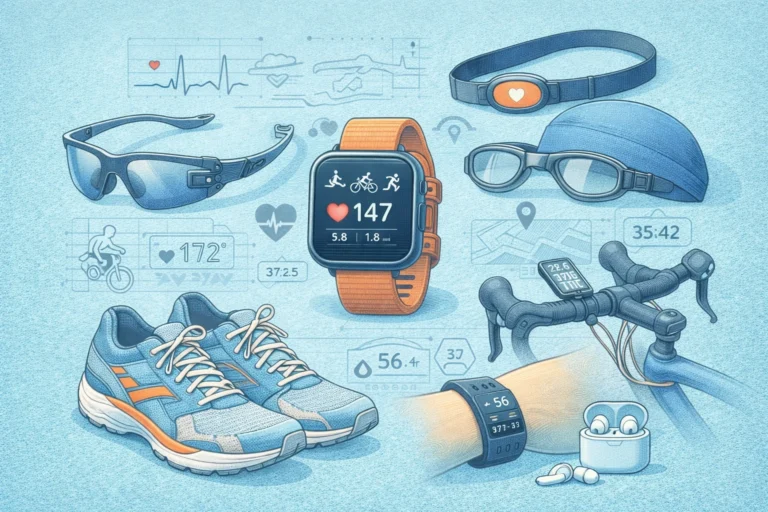
Wearable tech triathlonhealth has changed how athletes train, race, and recover. This article explains what gear matters, how to pick devices, and how to use them every day. You will find clear advice on watches, sensors, swim trackers, hydration tools, and useful accessories. Read on to find the best setup for your training and races.
Why wearable tech triathlonhealth matters for triathletes
Wearable tech triathlonhealth helps athletes measure what they do. Instead of guessing, you get numbers for pace, heart rate, power, and sleep. Those numbers let you train smarter and track real progress. They also help spot problems like overtraining or poor sleep.
Data gives context to workouts. A fast swim time feels good, but heart rate or stroke rate shows how hard you worked. On the bike, power tells a different story than speed. That detail matters before a race and during base training blocks.
Wearables also make race-day decisions easier. Live pace and power help you stay on plan. Real-time data reduces stress. You feel more confident because you can see the facts and adjust effort as needed.
Types of wearable tech triathlonhealth
Wearable tech triathlonhealth comes in many forms. Each type tracks different parts of training and recovery. Knowing the strengths of each device helps you pick the right tools for your goals and budget.
Some devices focus on one sport, like swim trackers. Others track everything, like multisport watches. There are small sensors for cadence or power and larger platforms for data analysis. Each plays a role in a balanced setup.
Many athletes use more than one device. A watch for navigation and a chest strap for accurate heart rate is a common combo. Pairing devices gives you both convenience and precision.
GPS watches
GPS watches are the most visible wearable tech triathlonhealth. They provide distance, pace, elevation, and often navigation. A good watch also offers multisport modes that switch between swim, bike, and run easily.
Modern watches add maps, live tracking, and multisensor inputs. You can connect a power meter, cadence sensor, or smart trainer. Battery life varies, so pick a model that lasts through your longest training day or race.
Battery saving modes, navigation cues, and race profiles are key features to compare. Think about screen readability in bright sun and how easy the buttons or touchscreen are with wet hands.
Heart rate and power meters
Heart rate sensors and power meters give objective effort data. Heart rate monitors come as chest straps or optical wrist sensors. Chest straps tend to be more accurate during intense efforts and sprints.
Power meters measure force on the bike and sometimes on pace while running. Power is useful because it is not as affected by wind or hills as speed. Many coaches base training plans on power zones for cycling.
Combining heart rate and power data helps you understand fatigue, fitness gains, and recovery. For races, a consistent power target will help prevent blowing up on the bike leg.
Swim trackers
Swim tracking hardware includes wrist-based trackers and lane-based sensors. Wrist trackers log stroke count, distance, and tempo in open water and pools. Some watches can auto-detect stroke type and rest intervals.
Open-water swim features like GPS tracking and breadcrumb paths are helpful. Not all watches are equal in open water. Look for strong GPS performance and clear swim mode options if you race in lakes or oceans.
For pool swimmers, lap counting accuracy and easy interval entry are top priorities. Test how the watch handles flip turns and short intervals if you train in a 25-meter pool.
Nutrition and hydration monitors
Nutrition and hydration monitors are evolving fast. Some wearables track sweat rate or electrolyte loss. Others connect to smart bottle systems and reminders. These tools help manage fueling during long workouts and races.
Managing hydration and calories is a common source of error on race day. Wearable alerts and guided fueling plans reduce guesswork. They can remind you when to drink or eat based on time or effort.
For athletes who struggle with stomach upset, a hydration and nutrition plan tied to real data can prevent overeating on the bike and fading on the run. Devices that integrate with your watch make following the plan easier.
How to choose wearable tech triathlonhealth for your needs
Choosing the right wearable tech triathlonhealth starts with your goals. Ask whether you need help with consistency, speed, endurance, or race-day execution. Your training focus shapes the features that matter most.
Budget is part of the decision. Entry-level devices offer core metrics like distance and heart rate. Mid-range and high-end devices add power integration, maps, and advanced race features. Consider what you will use every week, not just what seems cool on launch day.
Also think about ecosystem and software. A device with simple file export and solid third-party support saves time. Many athletes prefer platforms that sync with their coach or training app of choice.
Durability and comfort matter too. Waterproofing, screen toughness, and strap comfort affect daily use. If a device irritates your skin or fails after one season, it becomes a tool you avoid instead of one you rely on.
Best features to look for in wearable tech triathlonhealth
Feature priority depends on your level and race goals. For beginners, reliable GPS and heart rate are enough. For competitive athletes, power metrics, advanced recovery analytics, and race mode features are critical.
Battery life is often overlooked. A watch that dies in hour five of a long day will cause stress. Look for devices that meet your longest training session plus buffer time for safety.
Connectivity matters for sensors and apps. Bluetooth and ANT+ compatibility means more sensor choices. Device pairing should be simple and stable so you do not miss key data mid-activity.
Another feature to evaluate is data clarity. The device display should show the metrics you need at a glance. Customizable data fields and clear alerts are more useful than many small, hard-to-read stats on one screen.
Top device recommendations for wearable tech triathlonhealth

Below is a clear set of device recommendations for different budgets and priorities. Each option suits a specific goal, whether you want price value, all-in-one features, or pro-level metrics. Read each short review to match a device to your plan.
Pick a device that fits your training plan, battery needs, and comfort. These picks are based on reliability, feature set, and real-world use by triathletes. Remember that adding a sensor like a power meter or chest strap often improves data quality without replacing the watch.
The following devices are recommended for their balance of features, support, and price. Each has strengths for triathletes of different levels.
- Versatile multisport watch, great for athletes who want maps, long battery life, and advanced metrics. This model supports multisport profiles, route navigation, and power meter pairing.
- Value GPS watch, designed for budget-conscious athletes who need reliable GPS and basic swim, bike, run tracking. Good battery for long workouts and simple training features.
- Triathlon-focused watch, built with quick transitions, open-water swim tracking, and race pacing tools. Includes strong lap detection and multisport data screens.
- Dedicated bike power meter, for cyclists and triathletes who want precise power-based training. Pair with a compatible head unit or watch for best results.
- Chest strap heart rate monitor, for accurate heart rate data during hard efforts and interval sessions. More accurate than wrist optical sensors, especially during sprints.
Integrating wearable tech triathlonhealth with training plans and race day
Integration is where wearable tech triathlonhealth shows its value. Set up your watch and sensors so they match your training plan and race-day targets. That reduces confusion and helps you stick to the plan under pressure.
Before a training block, set zones for pace, heart rate, and power. Use a reliable test to find these zones. Once set, your watch can guide each session and help your coach track progress remotely.
Practice with your devices. Use the same alert settings and screen layouts you plan to use on race day. Wear the full kit in race-pace workouts so you know how it will feel. Small issues are easier to fix ahead of time than minutes before a race.
On race day, simplify. Show only the fields you need. Reduce unnecessary alerts. If you use an external sensor, check battery and pairing well before the race starts. A pre-race routine that includes a quick sensor check reduces stress.
Maintenance, data security, and battery tips for wearable tech triathlonhealth
Proper maintenance extends device life and accuracy. Rinse watches and sensors after open-water sessions. Replace straps or bands that show wear. Keep charging contacts clean and dry to avoid corrosion.
Battery management is practical. Charge devices the night before long sessions. Use a low-power GPS mode for long base rides when fine location detail is not required. Consider carrying a small external battery for ultra distances.
Data security is often overlooked. Use strong passwords for platforms that store your data. Enable two-factor authentication where available. Review app permissions and be cautious sharing sensitive training locations publicly.
Back up your training data regularly by syncing to a stable platform. That preserves your training history and makes it easier to share data with a coach or analyze long-term trends.
Useful accessories and extras for wearable tech triathlonhealth
Accessories improve comfort, mounting, and data quality for wearable tech triathlonhealth. Think about extras that match your sport and device setup. These small items can save time and improve race performance.
Before a long race, you may want spare bands, charging cables, or a dedicated bike mount. A secure mount keeps the watch visible on climbs and during transitions. For wrist comfort, try different strap materials until you find the best fit.
Below is a short list of helpful accessories. These items are commonly used by triathletes and provide practical value on race day and in training. Each item supports reliable data collection and easier device use.
- Spare charging cable and small power bank, for long events or travel. Carrying a spare can save a race if the main charger gets lost.
- Bike computer mount or out-front mount, for clear line-of-sight while riding. Choose a mount that fits your handlebar type and keeps the display stable.
- Chest strap heart rate monitor and quick-release band, for more accurate heart rate data during intense sessions and brick workouts.
- Silicone or fabric watch bands, for comfort in long swims and sweaty rides. Some materials cause less irritation during multi-hour sessions.
- Hydration packs and bottle systems. For example, hydration packs triathlonhealth designs or similar products help you manage fluids and electrolytes consistently.
Finally, consider branded bundles from your platform of choice. Collections labeled triathlonhealth watch selection or triathlonhealth accessories often pair the right mounts and bands with the watch to make setup easy. Look for kits that match your chosen device to avoid compatibility issues.
Battery and sensor pairing checklist before races
Having a pre-race checklist for your wearable tech triathlonhealth reduces surprises. This small routine ensures all devices are paired, charged, and configured. Follow the steps below each time you face a long session or an event.
The checklist should be simple and repeatable. It is best to run it twice, once the night before and once an hour before race start. Make a habit of checking battery levels and sensor pairing to avoid last-minute panic.
Below is a compact checklist you can copy into a pre-race routine. Use it to confirm everything is ready and avoid common errors that cost time or performance on race day.
- Full device charge the night before and a quick top-up three hours before start.
- Pair all external sensors, then do a short test ride or run to confirm data streams.
- Set race mode screens to only show necessary fields like pace, power, and elapsed time.
- Attach mounts and secure bands. Check for rubbing points on your skin with a short test.
- Pack spare cables, battery pack, and a small tool kit for minor adjustments.
Integrating emerging tech with proven practices
New technologies keep arriving, but established training principles still matter. Use modern devices to support time-tested plans. A watch will not replace consistent training, proper pacing, and good recovery habits.
One practical way to combine new tech with old-school coaching is to collect objective data and then apply standard training blocks. Use wearable tech triathlonhealth to track improvements, then adjust training volume and intensity using proven progression rules.
Technology can help spot small trends before they become big problems. For example, rising resting heart rate or poorer sleep may indicate the need for an easier week. Use data as a prompt, then apply coach-led adjustments based on your history and goals.
Key Takeaways
Wearable tech triathlonhealth offers real benefits for triathletes of all levels. It provides objective data on effort, recovery, and performance. With the right setup, devices guide training decisions and improve race-day execution.
Choose gear that matches your goals, budget, and ecosystem. Prioritize battery life, data clarity, and reliable sensor pairing. Test gear in training to ensure the setup is comfortable and consistent.
Use accessories to improve comfort and data reliability. Items listed under triathlonhealth innovative accessories and triathlonhealth accessories can simplify setup. Consider hydration packs triathlonhealth if you need convenient fluid management during long events.
Finally, the best wearable tech triathlonhealth setup is one you use consistently. Keep devices charged, maintain them, and use the data to make small, steady improvements. That approach yields the most reliable gains across training cycles and race seasons.